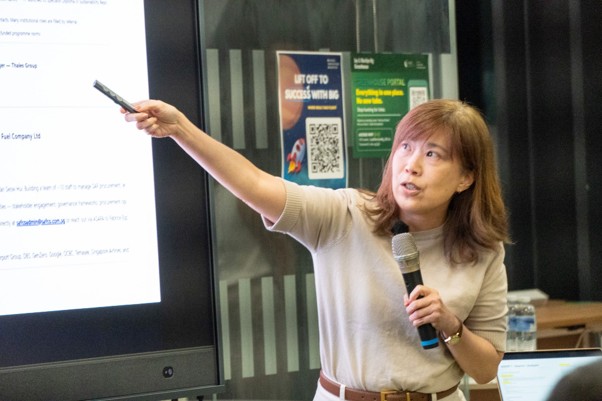
Search. Insight. Influence. — Showcase Night | AI Native Circle Pilot
I didn't set out to build a suite of career tools. The starting point was much smaller — a question that kept surfacing in my training classes.
Over the past year, I met many capable professionals navigating career transitions, retrenchment, or uncertainty — people with deep experience but difficulty articulating where they fit next.
The issue was rarely capability. It was clarity.
What if AI could help people see the value they already carry?
The people I met weren't lacking experience or effort. Most had spent years building experience, solving problems, leading teams, adapting through change. But they were stuck in a specific way: they couldn't translate what they'd done into what they could offer next. They were spending hours searching across job boards, industry news, and interview guides with no clear thread. Even when they knew where they wanted to go, they weren't always sure how to show up with confidence in the room.
Three distinct problems. Three practical tools.
Navigate → Understand → Respond
Navigate — Career Intelligence Agent
A tool designed to identify transferable strengths, surface potential role fits, and reduce the noise of fragmented job searching. Every Monday, it delivers curated insights directly to my inbox.
What surprised me was that it rarely uncovered completely new paths. Instead, it reframed existing experience. Skills I had mentally categorised as "situational" or "industry-specific" kept reappearing as valuable differentiators elsewhere.
The agent wasn't inventing capability. It was making visible what I had stopped seeing. That distinction stayed with me.
Understand — Industry Research Agent
A research agent designed to track trends, signals, and developments in Sustainable Aviation Fuel (SAF) — delivering structured weekly briefings with cited sources.
Initially, I thought the value would come from having more information. Instead, the shift was behavioural. Walking into conversations with stronger context changed how I listened. I became less focused on trying to prove myself and more focused on asking better questions, spotting patterns, and understanding what stakeholders were actually concerned about.
The confidence came less from "having answers" and more from reducing uncertainty.
Respond — Boardroom Coach Simulator
A simulation environment with different personas — executives, stakeholders, customers, interview panels — designed to practise high-stakes conversations under pressure.
The unexpected insight came from the debriefs after each session. Patterns became visible very quickly: where and when I over-explained, where I softened points unnecessarily, where I became defensive instead of curious.
The simulations were useful. But the reflection afterwards was where the real preparation happened.
After a few sessions I started noticing the same moment — the one where I went vague. That was the thing worth practising around.
The Transformation
I initially thought I was building tools to help people navigate career uncertainty. What I slowly realised was that the problem wasn't really information. It was that people had stopped trusting their own experience as still being relevant.
Most of the professionals I met were not lacking skills. They had simply lost visibility of how their experience still translated into value in a different context. The agents did not create capability. They surfaced what was already there.
That changed how people approached conversations, opportunities, and decisions. Including me.
What I Learned
This project also changed how I think about AI itself. The more I experimented, the more I realised that while the technical side has a steep learning curve, the much harder and more important part was defining the problem clearly enough for AI to support meaningfully.
Some prompts worked immediately. Most didn't. Every failed output forced a better question: What problem am I actually solving? What signal matters? What kind of clarity is missing?
That process — refining, testing, observing, adjusting — became its own form of practice.
You do not need to be highly technical to build something useful. But you do need to stay close to the human problem. The moment I focused on what sounded impressive instead of what was genuinely needed, the tools became less useful. That lesson applies far beyond AI.
Presented at Showcase Night as part of the AI Native Circle pilot. Watch the presentation on YouTube.
With thanks to Courage Chapter and ANCHR AI Labs for creating space for experimentation, reflection, and work-in-progress to be shared.