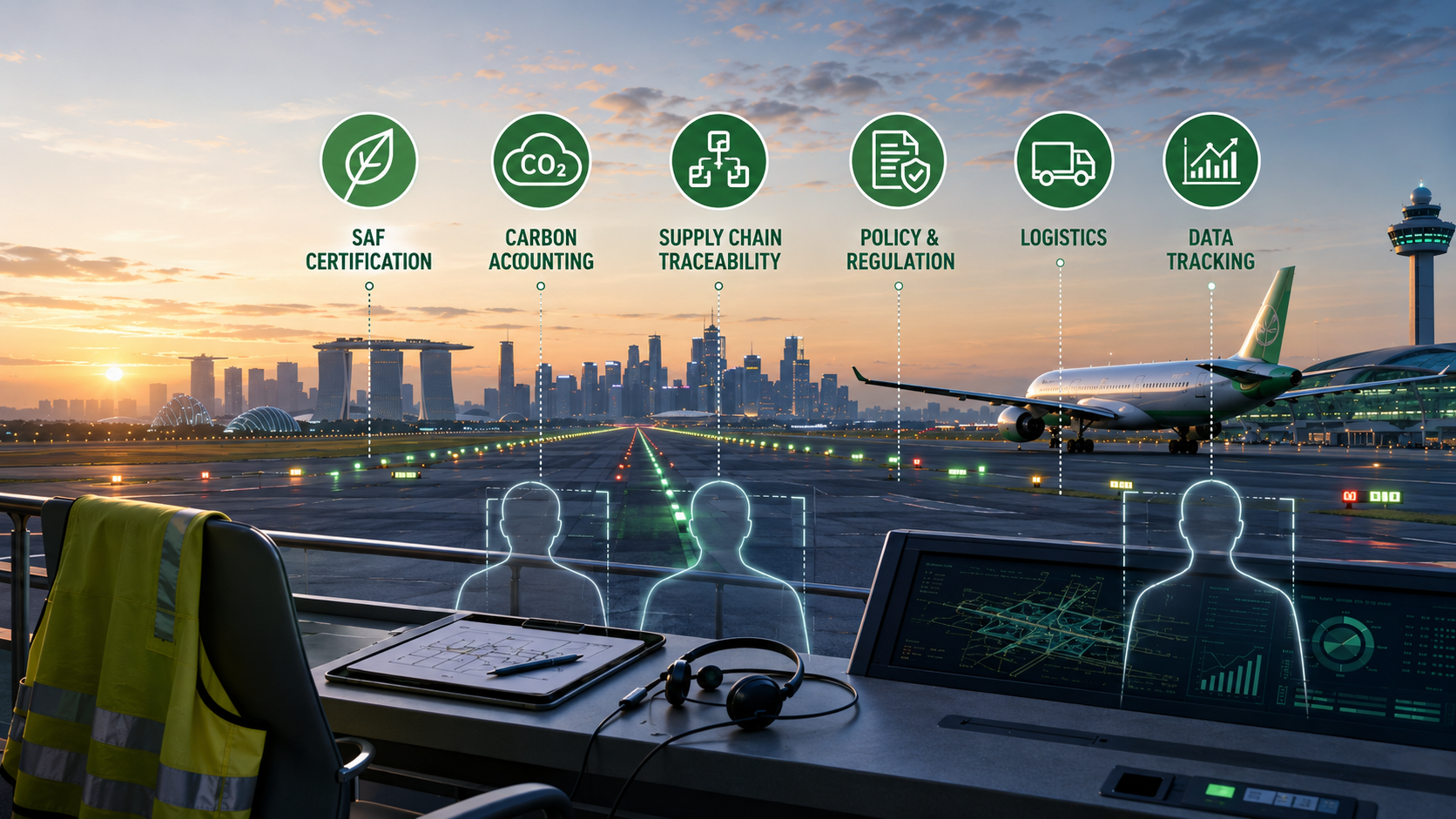
"The runway is being built. The question worth asking — now, not in 2030 — is who we are training to run it."
Check your next flight booking out of Changi. Somewhere in the fare breakdown, there is a new line item — a SAF levy, introduced this year as part of Singapore's mandatory requirement that 1% of all jet fuel on departing flights must be Sustainable Aviation Fuel, rising to 3–5% by 2030.
Most people will read it as a cost. A surcharge. Another fee absorbed into the price of travel. That reading is not wrong, but it is incomplete.
Around the same time, Singapore's carbon tax rose to S$45 per tonne — part of a trajectory toward S$50–80 by 2030. Both were reported as cost stories. The numbers are real: SAF currently costs airlines roughly US$3,000 per metric tonne, and at 0.8% of global jet fuel use, it already costs the industry US$4.3 billion annually.
But there is a different question hiding inside these numbers. Not what it costs. What it requires.
A Capacity Paradox
Here is a fact that deserves more attention than it gets: the global production capacity for SAF has expanded to nine million tonnes in 2026. Actual production is expected to reach 2.4 million tonnes.
The industry can make more than three times what it is making. The constraint is not technology. It is everything around the technology: feedstock supply chains, certification systems, blending logistics, policy design, investment sequencing, and the coordination required to get all of them moving at once.
IATA's director general was blunt at the organisation's June AGM: poorly designed mandates have stalled momentum, policy incentives favour renewable diesel for vehicles over green jet fuel, and the path to net-zero by 2050 is growing harder with each year of inaction. The problem is not scarcity of raw material. It is a mismatch between where incentives point and where the industry needs to go.
What This Transition Actually Requires
The SAF levy uses what CAAS calls a "fixed cost envelope" approach — centralised procurement, aggregated demand, predictable cost to airlines. It also assumes that the people, processes, and supply chain relationships needed to execute it will exist.
Behind the policy architecture is a question that rarely surfaces in industry briefings or sustainability roundtables: who does this work?
SAF certification is a specialised discipline. Feedstock traceability requires supply chain expertise applied to new material categories. Carbon accounting for aviation demands both technical fluency and regulatory knowledge. And emerging mechanisms like IATA's proposed "book and claim" system — which decouples the physical use of SAF from the claiming of its carbon benefits — add further complexity that someone has to understand and manage.
These are not niche roles. They are the roles that will determine whether Singapore's green aviation ambitions translate from mandate to reality.
A Question of Pace
The policy ambition is clear. What is less clear is whether the talent development ecosystem is moving at the same pace.
Career conversion programmes in Singapore's sustainability space have tended to operate at a general ESG level — broad frameworks, foundational literacy, introductory exposure to reporting and disclosure. This serves a purpose. But the roles that the green aviation transition actually requires sit somewhere more specific: feedstock certification, carbon accounting for aviation, supply chain traceability, CORSIA credit management.
Programmes that venture into specialised areas are emerging, but they tend to cover concepts rather than build operational capability — and there is a meaningful difference between understanding what carbon accounting is and being able to do it inside an organisation with real compliance obligations.
This is not a criticism of intent, nor of any specific provider or programme. Curriculum development lags industry transitions by design — it takes time to understand what a new role actually requires before you can train for it. But the lag matters here, because the mandates are not waiting. The 1% target is live. The carbon tax is rising. The roles are being created now.
The question is not whether Singapore will eventually close this gap. It is whether it closes it quickly enough to develop the local talent pipeline before organisations default to importing the capability instead.
Reading the Carbon Tax as a Career Map
There is a way to read the carbon tax that almost nobody talks about publicly.
When carbon gets expensive, organisations do not just absorb the cost. They restructure around it — hiring people who can reduce it, report it, and manage the obligations it creates. According to LinkedIn's 2025 Green Skills Report, more than half of all green hires now sit in non-green job titles — roles being filled by people from finance, accounting, engineering, operations, and procurement who are embedding a sustainability lens into work they already know how to do. The sustainability transition is not being built by sustainability purists. It is being built by people who pivot.
The carbon tax rising from S$25 to S$45 per tonne this year, and toward S$80 by 2030, is not just a compliance signal. It is a labour market signal. It is telling organisations what capabilities they will need to have in-house, and telling individuals which pivots are worth making.
The question is whether Singapore's training ecosystem is translating that signal — or whether it is still producing general sustainability awareness while the actual demand has moved somewhere more specific.
Singapore has the policy architecture — the mandate, the levy, the central procurement model, national carriers already part of global alliances to scale the carbon credit market SAF depends on. What it does not yet have is a talent development system calibrated to match.
The runway is being built. The question worth asking — now, not in 2030 — is who we are training to run it.
The observations in this piece reflect my personal perspective as a practitioner working across career development and organisational learning. They are not intended as a critique of any specific institution, training provider, or industry body — but as a reflection on a gap I believe is worth naming, and worth closing.
Sources & references
- Carbon tax trajectory: Hogan Lovells, ESG Compliance: Current State, Global Trends, and Outlook 2026 (February 2026)
- SAF levy: CAAS, New Sustainable Aviation Fuel Levy to Apply from 1 April 2026
- SAF production figures: IATA, SAF Production Volumes Still Disappointing (June 2026)
- IATA AGM reporting: Esther Loi, IATA urges bigger green aviation fuel push as production stagnates and prices rise, The Straits Times (8 June 2026)
- Green skills and career transition: LinkedIn Global Green Skills Report 2025 (December 2025)