Helping people translate experience into direction.
The Career Intelligence Agent started from a frustration I kept seeing repeatedly in training classes and career conversations: people often know what they have done, but struggle to explain where those experiences still create value.
The problem wasn't a lack of effort. It was fragmentation — job searches spread across multiple platforms, disconnected industry research, uncertainty around transferable skills, and difficulty identifying realistic role fit.
What the Agent Does
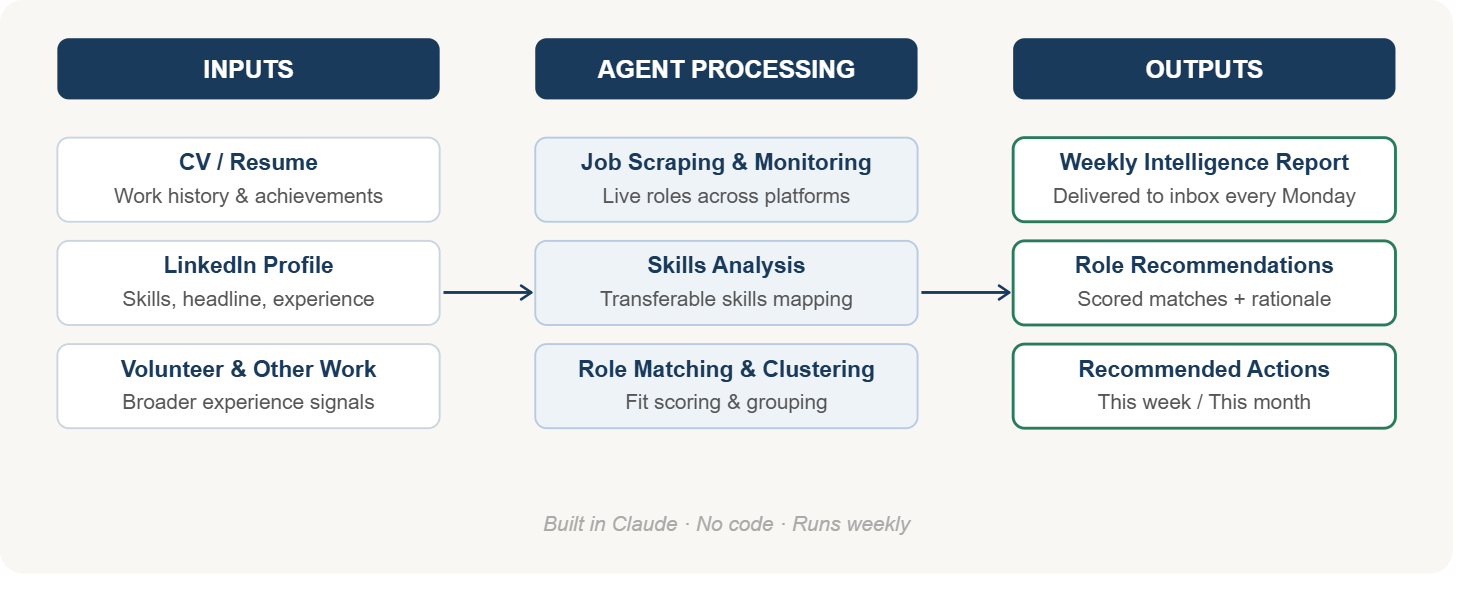
The agent combines several functions into one structured weekly workflow:
- Job search monitoring across relevant platforms and roles
- Transferable skills analysis based on my background
- Role matching and fit scoring
- Market intelligence: salary trends, title shifts, emerging demand
- Weekly curated summary delivered directly to inbox
The output isn't a list of job links. It provides context — what's moving in the market, which roles align with my background, and what actions are worth taking this week versus this month.
How I Built It
Built entirely in Claude — no coding. The construction is prompt-based: I designed a structured set of instructions that Claude runs as a repeating workflow. The starting point was my CV, LinkedIn profile, and volunteer activities — I used my own profile as the test case, partly because it was the most immediate input available, and partly because going through the process myself was the most reliable way to understand what it would surface for others. From there, I designed a set of prompts I could run as a repeating workflow: feed in the inputs, run the analysis, get a structured report.
Most of the early iterations didn't work. I had built in too many asks at once, and the prompts became too convoluted. Outputs were either too broad to be useful or too narrow to surface anything interesting.
The refinement process forced me to be more specific about what I actually wanted — not just "find relevant jobs," but roles where my operations experience, combined with skills built outside of work, could be an asset in industries beyond where I had been.
I deliberately left out target industries and roles. I wanted the agent to surface directions I hadn't already considered — and it did, surfacing roles that drew on my operations background in contexts I'd written off as out of reach.
The scheduling piece was straightforward: I used Claude's scheduling feature to run it every Monday morning, so the report lands in my inbox before the week starts.
Agent Workflow Diagram
What the Agent Produces
Each Monday report has two main sections.
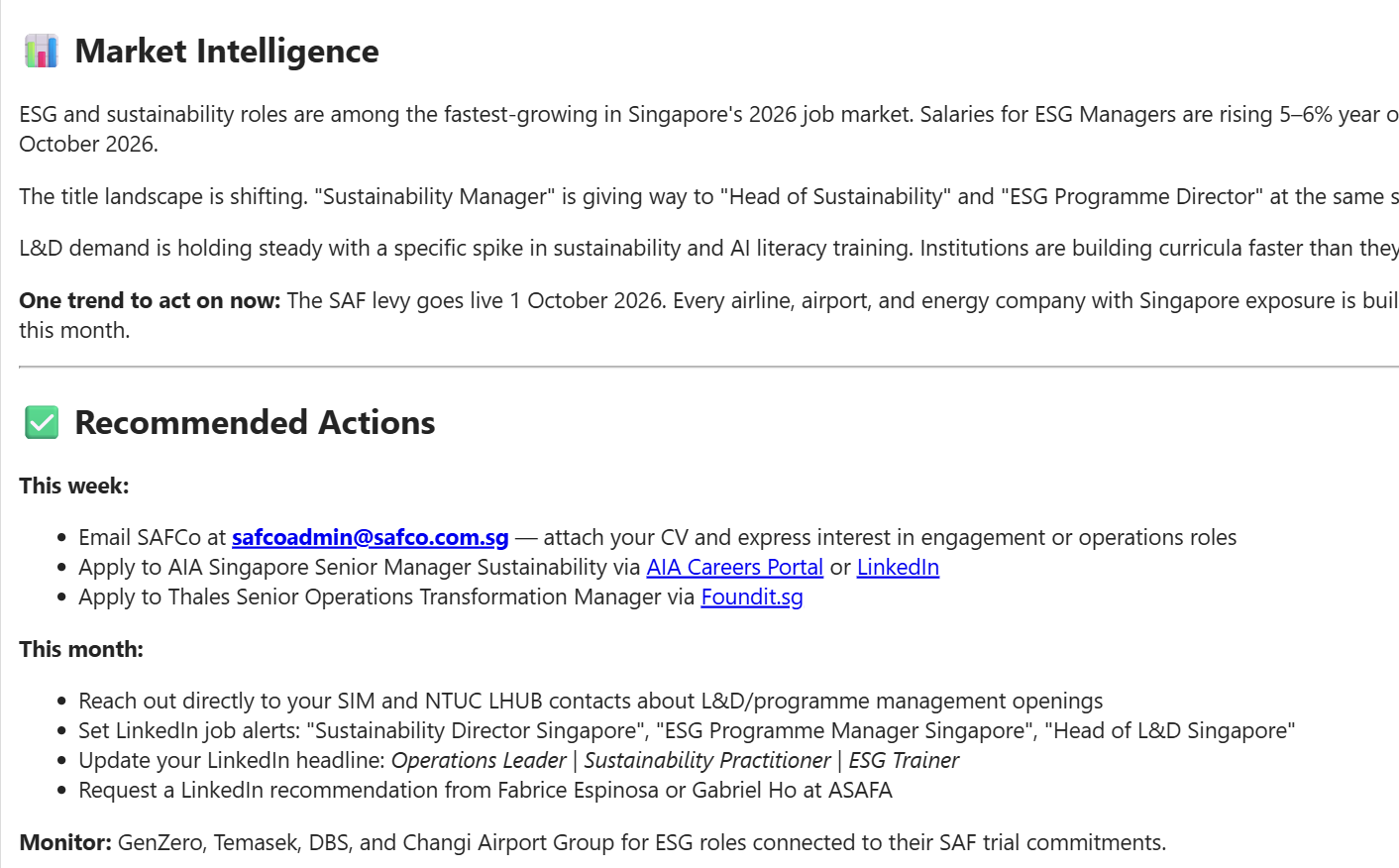
The first is a market intelligence summary — what's shifting in the roles and industries I'm tracking, salary signals, title changes, and one trend flagged as immediately actionable.
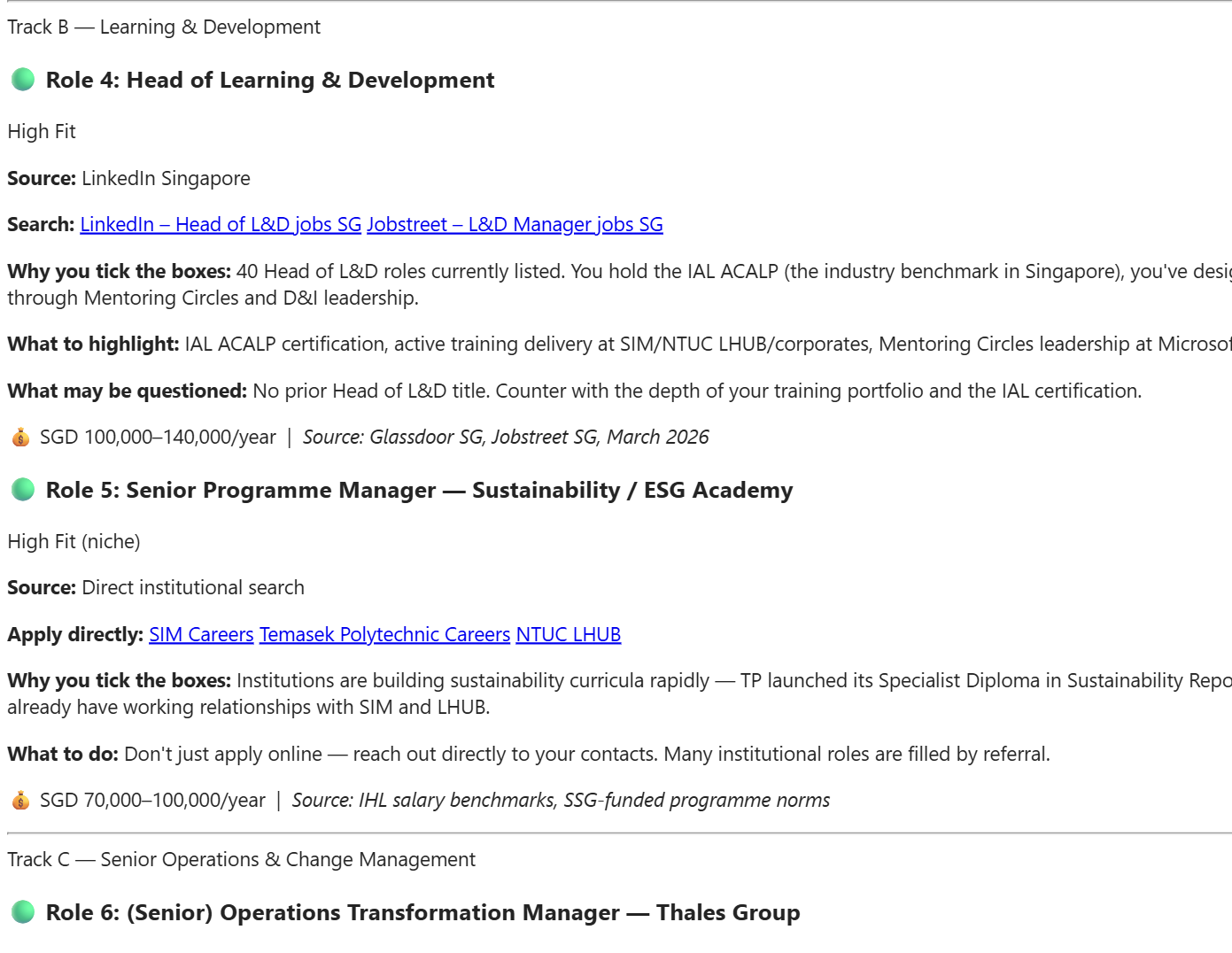
The second is a recommended actions list, split into what to act on this week and what to work on across the month. The actions are specific: named companies, named roles, specific platforms to apply through, and LinkedIn optimisation steps. It also flags organisations to monitor based on their known commitments in areas relevant to my background.
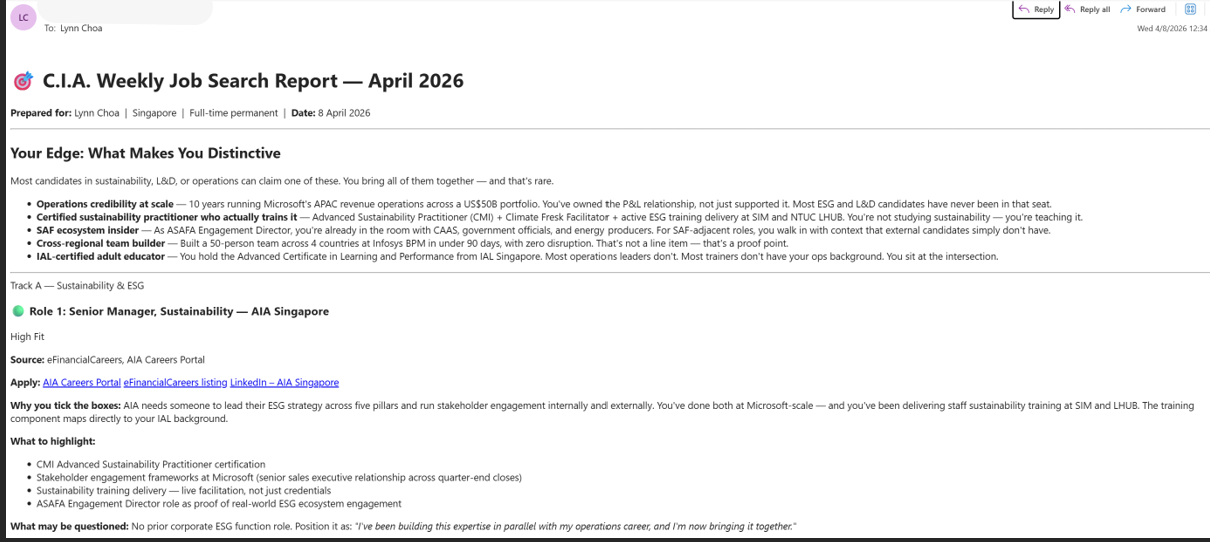
The section I found most useful wasn't the job listings. It was a paragraph the agent generates on my distinct edge and narrative — identifying what makes my combination of experience unusual, how to articulate it, and what I specifically bring to the table. That framing proved more durable than any individual role recommendation.
The following are example outputs from an actual session.

What It Revealed
The most interesting finding was that the agent rarely uncovered completely new directions. Instead, it reframed existing experience — surfacing adjacent roles that drew on the same underlying capabilities in ways I hadn't considered.
The agent wasn't generating capability. It was making visible what had become difficult to see manually. That distinction — between creating something new and revealing what's already there — turned out to be the more useful insight.
What I'd Build Next
The agent was built for participants in my training classes — people navigating career transitions who struggle to connect their experience to where it still creates value. The principle behind the design is straightforward: if the search is automated, the time that would have gone to scanning job boards gets redirected to preparation — understanding industries, sharpening the narrative, tailoring applications. For someone mid-transition, that shift in where the effort goes matters more than the search itself.
The biggest limitation was repetition. The same opportunities often appeared week after week, including roles I had already ruled out. Because the agent had no memory of my previous decisions, it treated every search as if it were starting from scratch.
Looking back, the first improvement I would make is not a better search engine, but a better feedback mechanism. A simple way to record "not relevant", "already applied", or "not interested" would allow the system to learn from prior decisions and focus attention on genuinely new opportunities. The objective is not more results; it is better signal-to-noise.