Turning fragmented information into usable context.
I kept noticing the same thing: people who struggled in stakeholder conversations weren't underprepared on their own work. They were underprepared on the world the other person was living in. Strong operational or leadership experience didn't help much if you were unfamiliar with the market signals, vocabulary, or priorities that mattered to the person across the table.
The question I kept coming back to was simple: what would it take to walk into any room already knowing what mattered to the people in it?
That's what this agent is designed to do.
What the Agent Does
The agent monitors and consolidates Sustainable Aviation Fuel (SAF) news, market developments, emerging technologies, policy changes, and sector signals into structured weekly briefings.
- Trend monitoring across SAF industry developments
- Signal extraction from news, reports, announcements, and publications
- Topic clustering and relevance ranking
- Weekly intelligence briefings delivered to inbox
The output isn't a news dump. It's a filtered, structured summary of what's shifting — and what's worth paying attention to before my next conversation.
How I Built It
Built entirely in Claude — no coding. The construction is prompt-based: I designed a structured set of instructions that Claude runs as a repeating workflow. The setup started with defining the topics I wanted to track within SAF — policy developments, technology advances, investment activity, and market signals.
Two design decisions made a significant difference.
First, I specified the sources the agent should draw from rather than letting it range freely. This kept the output grounded and consistent rather than pulling from wherever happened to rank highest. Without that constraint, early versions produced briefings that were broad but unreliable — content that looked authoritative but wasn't always traceable.
Second, I explicitly instructed the agent not to hallucinate — particularly for qualitative claims like industry challenges or stakeholder concerns. If the information wasn't clearly supported by a source, I wanted it left out rather than inferred. Citing the source for every insight became a non-negotiable part of the output format.
Those two constraints — curated sources and citation discipline — are what make the briefings usable rather than just interesting.
The scheduling piece was straightforward: I used Claude's scheduling feature to run it weekly, so the briefing lands in my inbox before the week starts.
What the Agent Produces
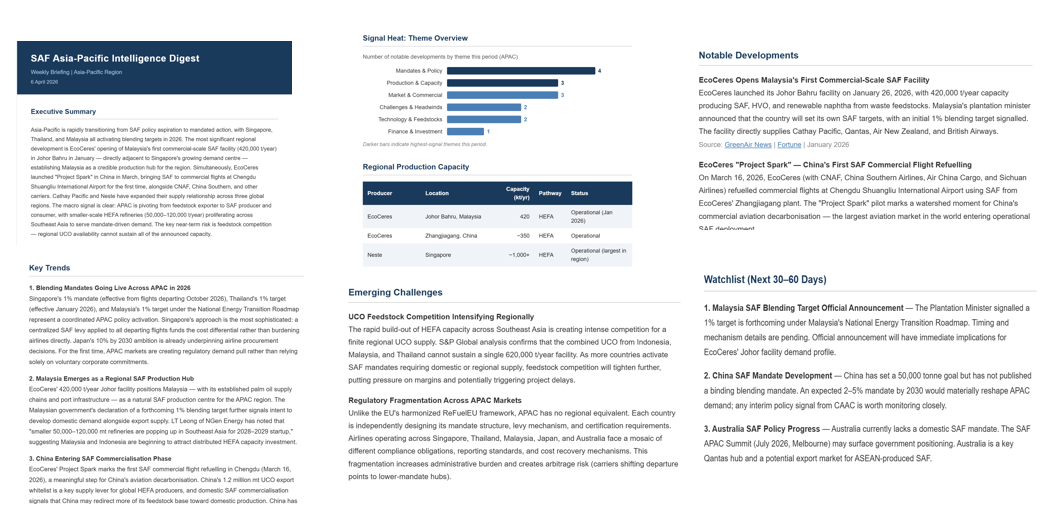
Each weekly briefing is structured by theme rather than by source. Rather than listing what each publication covered, it groups signals by what's actually shifting: a regulatory development, a technology change that alters the competitive picture, a narrative gaining traction across the sector.
Each theme gets a short summary, the signal worth noting, and the source it came from. If I want to follow up on something or reference it in a conversation, I know exactly where it came from.
The following is an example output from an actual session.
Sample: SAF Asia-Pacific Intelligence Digest
What Became Most Valuable
I initially assumed the value would come from having more information. Instead, the real shift was behavioural. Walking into networking events with stronger context changed how I listened, the questions I asked, and how quickly I could identify what mattered to the person I was talking to.
The confidence came less from knowing more, and more from knowing what to pay attention to. That's a different kind of preparation — and a harder one to manufacture without a structured system behind it.
How My Use of It Changed
When I first built the agent, I saw it primarily as a research tool — a way to stay informed about developments across the SAF ecosystem without spending hours monitoring multiple sources.
What became clear, though, was not the quality of the information, but its limitations.
At industry events and networking sessions, I occasionally found myself hearing about developments that were not yet reflected in the briefing report. The agent wasn't surfacing outdated information; it was accurately summarising what was publicly available at that point in time. The gap was between what had been published and what industry practitioners already knew through conversations, partnerships, and ongoing work.
That experience changed how I use the reports.
Today, I view them less as a source of definitive answers and more as a starting point for better conversations. The briefing helps me understand the landscape, identify emerging themes, and arrive prepared. But the most valuable insights still come from asking questions, listening carefully, and learning from people who are actively shaping the industry.
The lesson was a useful reminder that AI is exceptionally good at synthesising published knowledge, but some of the most important information travels through human networks long before it appears on the internet.